
For HVAC company owners · 6 min read
When the AC Dies, Homeowners Google It: Why HVAC Companies Need to Be Found on Google in 2026
The next homeowner with a dead AC is going to call somebody today. Here’s how to make sure it’s you, and not the company down the street.
The moment of need
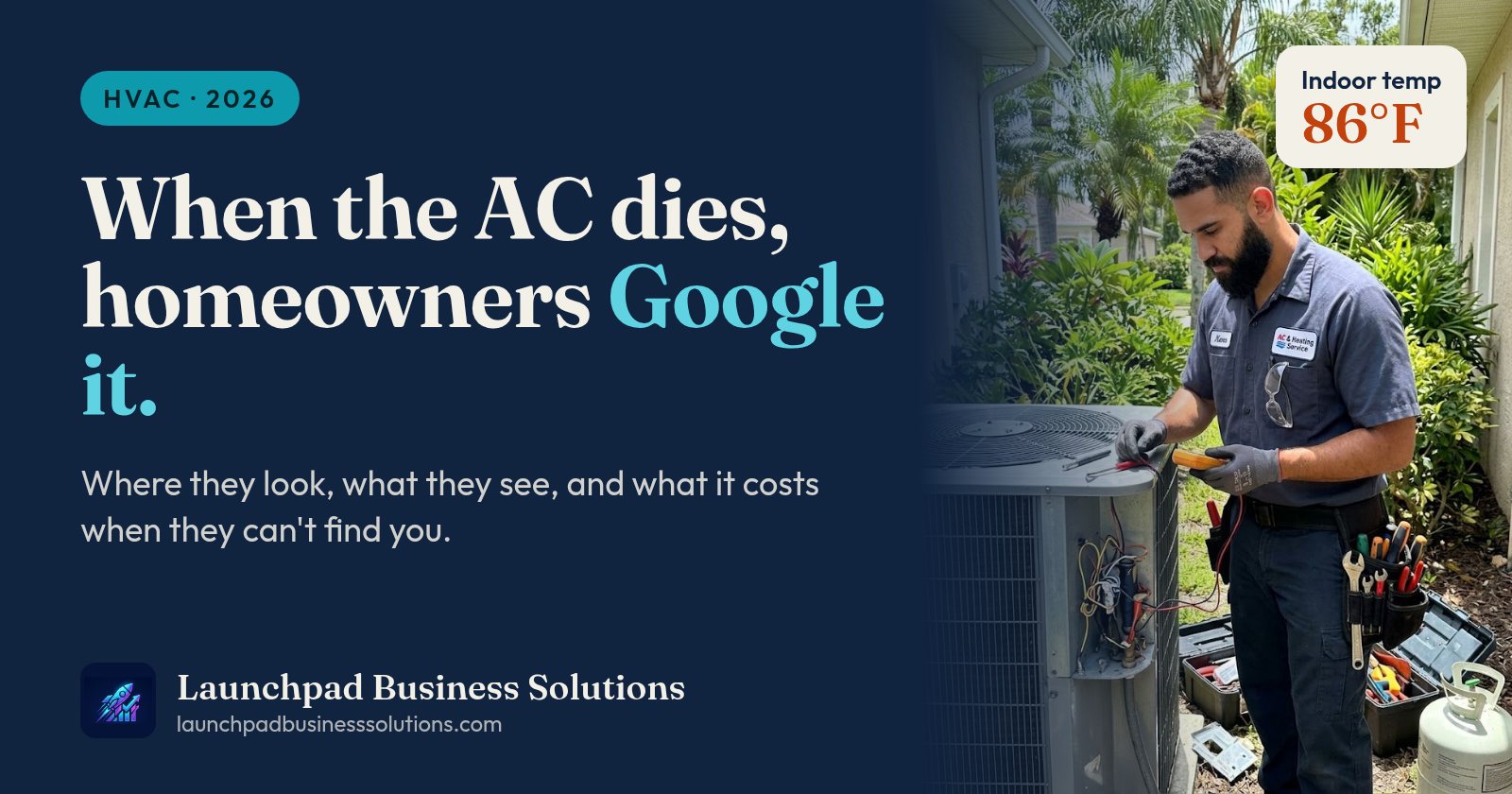
It’s 4:30 on a July afternoon. The thermostat says 74. The house says 86. The kids are melting, the dog is lying on the tile, and somebody is already pulling out a phone.
They are not flipping through a phone book. They’re typing “AC repair near me,” tapping one of the first few names they see, and calling. And speed wins: in Mantel’s 2025 homeowner survey, 49% said quick, responsive communication is what made the contractor they hired stand out.
This isn’t a “let’s get three quotes next month” problem. In a 2025 FIELDBOSS survey of 1,000 U.S. homeowners who had hired an HVAC pro, 47% said their single biggest HVAC worry is a breakdown during extreme heat or cold, and 74% expect service within 24 hours when the AC or heat goes out.
So the question isn’t whether that homeowner calls someone today. It’s whether they can find you before they find your competitor. Every hot afternoon you’re not showing up, those calls are going somewhere else.
Where homeowners actually look
The best recent data comes from Mantel’s Homeowner Shopping Attitudes Report 2025, a survey of 422 U.S. homeowners who shopped for heating and cooling in 2025 (published October 1, 2026). Google Search and Maps was the most common starting point, at 39.3%, ahead of calling a contractor they’d used before (33.6%) or a friend’s recommendation (25.6%). Among millennial homeowners, it was 62.1%.
Where homeowners start
Google is the #1 starting point for finding a heating & cooling contractor
- Google Search & Maps39.3%
- A contractor they used before33.6%
- Friend or neighbor recommendation25.6%
- Contractor websites16.7%
- Social media11.2%
- AI tools (ChatGPT, etc.)3.2%
Two more numbers from the same report should make every owner sit up. 52.5% check online reviews to judge a contractor before contacting anyone. And homeowners contacted just 2.1 contractors on average. That’s the whole shortlist. If you’re not one of those two, you never even get the chance to quote.
To be fair: referrals and repeat customers still matter a lot. In the FIELDBOSS survey, 69% hired a company they’d used before or one a friend recommended, and 17% found their provider through an online search. Great service keeps those customers coming back. But Google is where you win the people who don’t know you yet, and that’s how a growing HVAC company gets new customers in the first place.
What they see when they search
The map pack comes first. When Whitespark ran 540 searches across three U.S. cities (May 2025), the local “map pack” of three businesses showed up for 93% of local-intent searches, like “plumbers in Houston.” Google’s AI Overviews appeared on only 15% of those local searches. For a homeowner who needs someone today, the map is the storefront.
Then they read the reviews. BrightLocal’s Local Consumer Review Survey 2026 (1,002 U.S. adults, February 2026) found:
Read that middle one again. Nearly half of people won’t touch a business with fewer than 20 reviews, no matter how good the work is. And 68% will only use a business with four stars or better.
Then they check your website. After reading positive reviews, 54% of consumers go to the business’s website (BrightLocal, 2026). That’s your closing pitch. If it’s slow, hard to read on a phone, or hides the phone number, they hit the back button and call the next name on the list.
What it costs to be invisible
You can always rent your way to the top with ads. It works, and it’s fast. But nobody tells you how fast the meter runs.
The price of renting the top spot
What one HVAC lead costs from Google Ads
$127.74
Median AC install & repair search lead
$289
Average AC repair Google Ads lead
$353
Average AC install / replacement lead
$1,076
Priciest 10% of HVAC campaigns, May 2026
LocaliQ’s home services benchmarks (3,211 search campaigns, April 2024 to March 2025) put the median cost per lead for AC installation and repair at $127.74, with clicks around $9.68. Agency 99 Calls, looking at the HVAC campaigns it manages (published August 2026), says most HVAC companies pay $190 to $335 per lead, AC repair clicks averaged $56.71, and in May 2026 the most expensive 10% of campaigns paid over $1,000 per lead. Peak season is exactly when everyone bids at once.
Paying $289 for a lead is fine when it turns into a $9,000 system swap. It stings when it’s a guy asking whether you sell window units.
Here’s the part that matters: Google doesn’t charge per click for its regular map and organic listings. Showing up there isn’t free (it takes a real profile, real reviews, and a real website), but every call that comes from it doesn’t come with a meter running. The best setups use ads for speed and a strong Google presence to keep the average cost per job down over time.
The 5-step checklist
None of this guarantees the top spot. Nobody honest can promise that. But it puts you in the race.
- 1
Claim and finish your Google Business Profile.
Pick the right primary category, set your real service area and hours, list every service you offer (AC repair, installs, heat pumps, mini splits, maintenance plans), and add real photos of your trucks, team, and jobs. Keep it current.
- 2
Ask for reviews on a schedule, not in a panic.
Ask every happy customer, right after the job, with a direct link or QR code. BrightLocal found 83% of people who were asked went on to leave a review. Reply to every one. Never buy, fake, or script reviews; the FTC’s 2024 rule bans fake reviews, and Google blocks them.
- 3
Make your site fast on a phone, with tap-to-call.
Phone number at the top of every page, a big tap-to-call button, your service area, emergency hours, financing, and reviews. If someone has to pinch and zoom to find your number, you’ve already lost them.
- 4
Build service and city pages.
One page for each main service (AC repair, AC replacement, heat pumps, maintenance plans) and pages for the main cities you serve. 99 Calls recommends separate service landing pages for ads too, because they match what people searched.
- 5
Track your calls.
Use call tracking so you know which calls came from your Google profile, your website, and your ads. Measure cost per booked job, not cost per click. Then put more money behind whatever is actually booking work.
Sources for step 2: BrightLocal LCRS 2026 and the FTC’s final rule on fake reviews (Aug 2024). Step 4: 99 Calls, 2026.
The bottom line
Your AC customers aren’t loyal to an ad, and they aren’t patient in July. They’re loyal to whoever shows up first, looks trustworthy, and answers the phone. That can be you.
Questions about cost, timing, or what we need from you? Check our FAQ.
Keep reading
Sources
- Mantel, Homeowner Shopping Attitudes Report 2025: 422 U.S. homeowners, surveyed fall 2025, published Oct 1, 2026.
- FIELDBOSS HVAC Consumer Survey: 1,000 U.S. homeowners, via Pollfish, published July 30, 2025.
- Whitespark, The Prevalence of AI Overviews in Local Search: 540 manual searches in Houston, Phoenix, and Denver across six industries, May 12, 2025.
- BrightLocal, Local Consumer Review Survey 2026: 1,002 U.S. adults, published Feb 11, 2026.
- LocaliQ, Search Ad Benchmarks for Home Services: 3,211 U.S. campaigns, Apr 1, 2024 to Mar 21, 2025 (medians), updated July 15, 2026.
- 99 Calls, Google Ads Lead Costs for HVAC Services in 2026: campaigns managed by 99 Calls, Jan 2024 to Jun 2026, published Aug 4, 2026.
- FTC, Final Rule Banning Fake Reviews and Testimonials, Aug 14, 2024.